Global Trends ETF April 2024


- ETF and 401k asset allocation ideas.
- Expect some choppiness and potentially a small correction in Q2.
- Oil is likely to see a rising or firm price through summer.
- Bitcoin is expanding globally.
- China might cut a deal with the U.S.
Hello, welcome to the monthly Global Trends ETF Report. Use this report each month to help you with asset allocation for the ETF (or other funds) slice of your portfolio and your retirement plans at work. Please read the Using Global Trends ETF article in the Getting Started section before investing.
Economic Indicators Brief
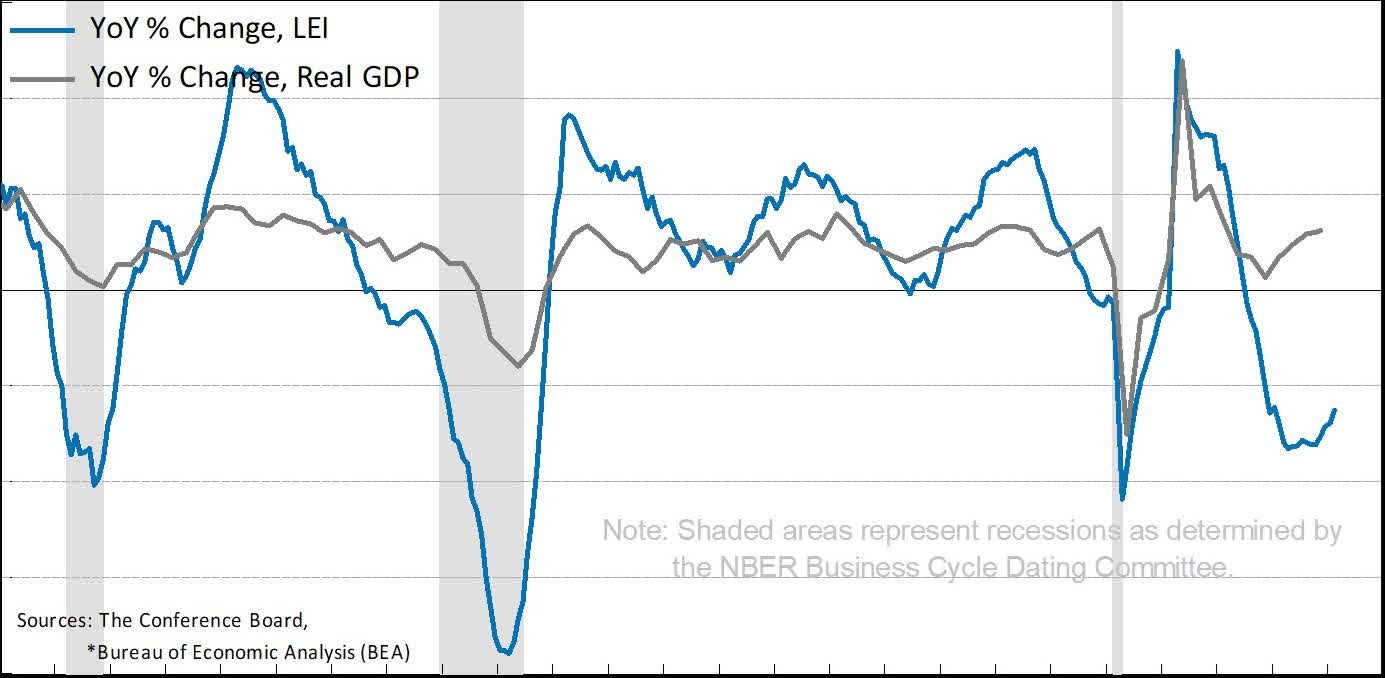
The U.S. Leading Economic Indicators rose in February 2024 for the first time since February 2022. The LEI was led by “Strength in weekly hours worked in manufacturing, stock prices, the Leading Credit Index™, and residential construction drove the LEI’s first monthly increase in two years.”
That new strength in the LEI suggests a potential reacceleration of the economy into summer off of what appears to be a cyclical bottom.
For March, America added 303,000 new jobs, far in excess of consensus estimates close to 200,000. The unemployment rate fell from 3.9% to 3.8%, which is indicative of full employment. The Labor Force Participation Rate held essentially steady on its recovery from Covid lows.

The Atlanta Fed’s GDPNow real GDP estimate is hovering at 2.5% for 2024 despite Federal Reserve tightening of financial conditions the past two years.
The ISM Manufacturing PMI (Purchasing Managers’ Index) just crossed above the expansionary 50 threshold to 50.3% and the ISM Services PMI remains stronger at 51.4%. This likely indicates that manufacturing, though strong in general, remains more cyclical than services which are proving to be in a strong secular trend.
Inflation, which gets most of the press post-Covid held it moderated levels after falling precipitously the past year. Various measures of PCE (Fed preferred) and CPI (public’s focus) range from 2.5% to 4.1% depending on the rolling period. There was a fractional uptick in inflation in February which bears watching.
The Federal Reserve has not committed to lowering rates yet as the economy remains firm, employment remains strong and inflation has essentially flattened at a level a bit higher than they would prefer.
Energy remains the most important wild card for inflation and that might be out of control of the Federal Reserve’s hands as OPEC continues to suppress their production. All the Fed can do is hold rates steady so that the dollar does not fall which would instigate inflationary pressures.
I’ll have a fuller article about the strength of the U.S. economy soon, the title is, “Don’t Call The U.S. Economy Goldilocks, Call It Goliath.”
The Dollar And U.S. Bond Market
The dollar remains in its 12 year bull market versus other currencies that I predicted in 2012.
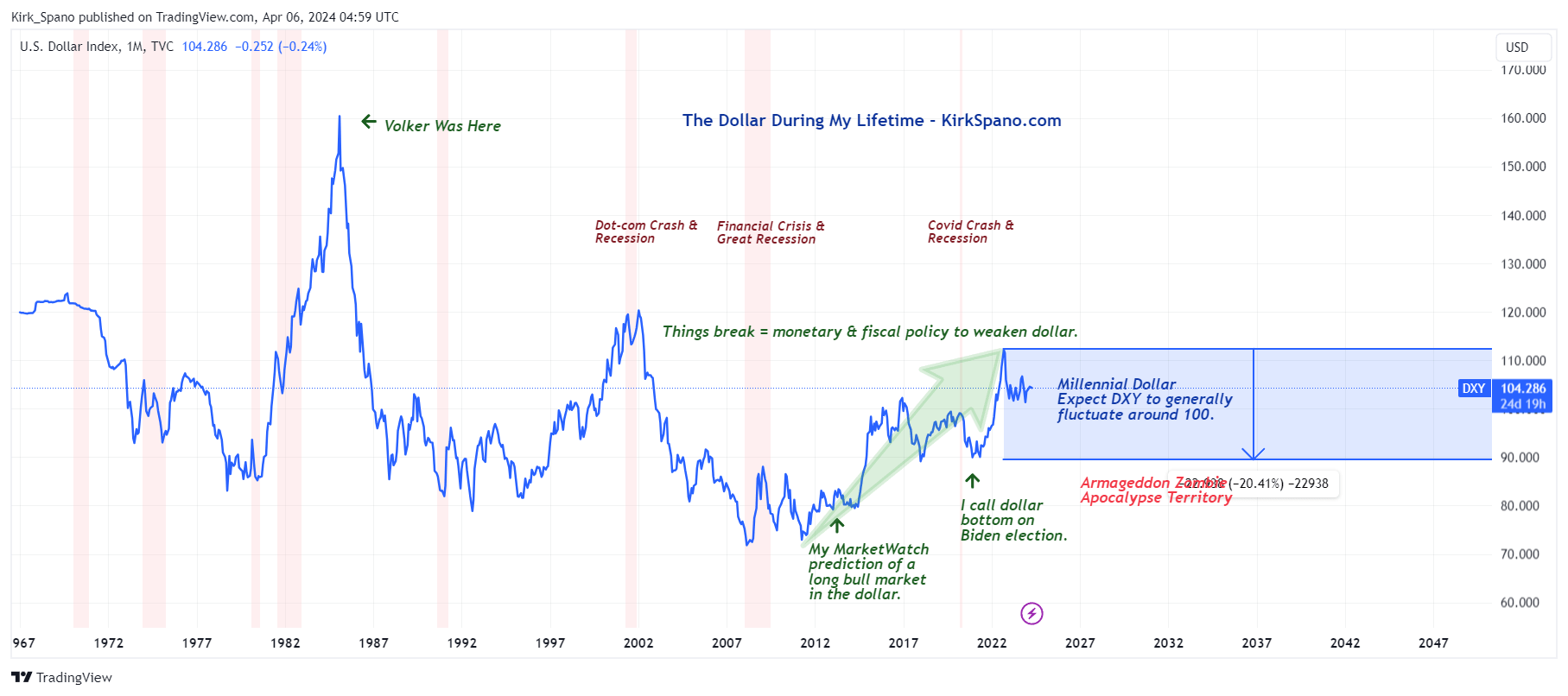
In the short run with conflict in the Middle East flaring and the Fed not cutting rates yet, we can see the dollar move higher. This would generally put pressure on asset, commodity and real estate prices. Supply and demand play a big role in pricing, so, stocks seem the most likely place to take a correction if the dollar rises towards $110 again on the DXY index.
The iShares 20+ Year Treasury Bond ETF (TLT) continues to chop along in the lower $90s. It is unlikely that it retests last year’s lows in the lower $80s unless there is an inflation scare.
An inflation scare could happen if OPEC manipulates oil higher into a strong economy. In that scenario, expensive oil eventually breaks the economy and supply chains causing both inflation and recession. Stagflation is difficult to fight, but I would expect a focus on employment to improve supply chains followed by fighting inflation. I hope OPEC is cautious, but we will see.
Policy errors in China, as they continue to exit their super high growth years, could be a recessionary spark if President Xi does not work towards a more symbiotic relationship with the U.S. again. Fighting a recession without inflation though has not proven to be a tough job for the Fed, so, we’d expect a rather rapid recovery.
We must keep reminding ourselves that deflation is the real long-term secular threat. There has only been inflation over 3% three times in the past 30 years. No commodity supercycle has emerged as a world awash in capital does the projects it needs to do.
For me, TLT is recession insurance and if it gets into the middle to lower $80s again, I would look at adding it to retiree portfolios and the Bluemound 401k model portfolio.
U.S. Stock Market
Large cap stocks are overvalued as a group, but not desperately just yet. While I expect a breather in price appreciation as the Fed stalls on lowering rates, I still a euphoric rally in the second half of the year.

I mentioned the following piece a couple months ago and would reiterate that the S&P 500 is a broken index due to about half of investors dollar cost average into that index, that is, mostly the indexers in Boglehead fashion.
Einhorn Says Markets ‘Fundamentally Broken’ By Passive, Quant Investing
That broken nature has pushed many crummy S&P 500 up in share price. At some point there will be an attrition from indexing when other asset classes outperform for an extended period. The leading edge of that will be institutions and foriegn direct investors putting their money elsewhere. That appears to already have begun as the small cap stocks began outperforming around New Year.
Bitcoin is also taking in a lot of money since January ETF introduction – more on that below.
The “Magnificent 7” have not performed as well this year with Apple (AAPL) and Tesla (TSLA) down for the year. Broader breadth is hitting the S&P 500 with more stocks participating to the upside. That number has approached 80% in Q1. A number in the 90s indicates a topping process.

I have increased my cash holdings in the past month due to a mix of the Federal Reserve being on pause, high valuations, seasonality and geopolitical concerns.
I am waiting to buy the Invesco QQQ (QQQ) which has led the S&P 500 most rolling time periods and because I believe the giant cash rich companies on that index will continue to lead. I’m looking for a 5-10% pullback to scale into.

I am also waiting to buy the Invesco Russell 1000 Dynamic Multifactor ETF (OMFL) which includes larger mid cap stocks that have been leading the market lately and has a basic quant model that tends to outperform the S&P 500 as well. I am looking to buy it on a pullback to about $50.

International And Emerging Markets
Emerging markets account for about half of global GDP and about two-thirds of global growth. They also are home to over 4 billion people with an average age of only 34 – considerably younger than developed markets average age of 41 according to World Economics. A younger population has more potential labor and fewer people on social programs (in theory).
Emerging markets are another “inefficient” market that requires some discernment. Certain countries are more “set up” for success than others. Factors such as age, education, technology, resources and rule of law are all important in emerging market success.
While we are looking for opportunities in more specific segments, it is good to look at the entire EM complex. Here is a look at the the very large iShares MSCI Emerging Markets Index (EEM).
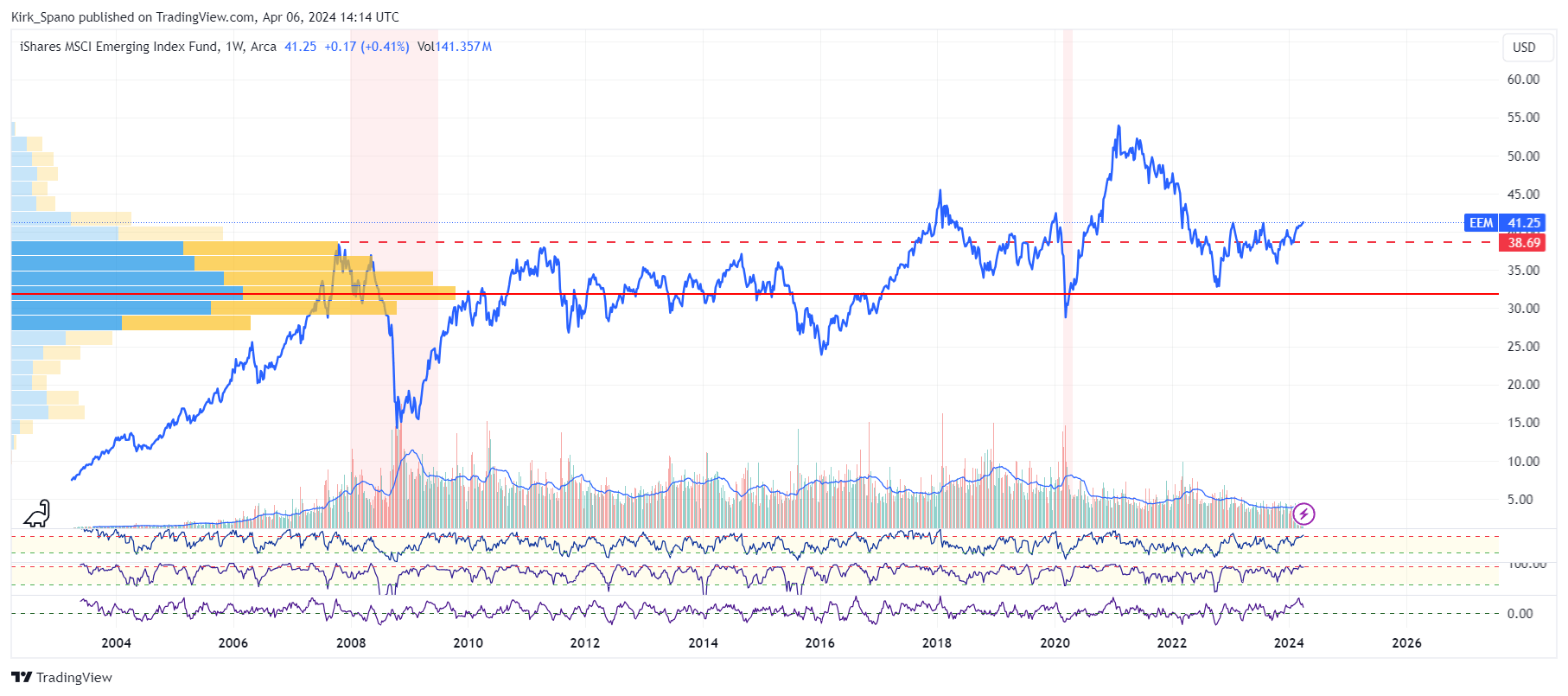
Currently, you can see the RSI and MFI both show that EEM is overbought on a weekly basis. That projects a small pullback at least. With the dollar firm, that makes a lot of sense. So, I am looking to buy a pullback in EMs as they have been flirting with breaking out for 6 years now from a 17 year choppy market.
I am still limiting my exposure to China, however, there appears to be a good chance of a U.S. and China deal on trade and other issues before the election, i.e. Taiwan. If that happens, then we will want to invest more into China as foriegn direct investment rebounds.

Bitcoin
With the advent of ETFs, Bitcoin has been invited into the institutional investment realm. Incorporation into the U.S. financial system should not be underestimated. This is a big deal.
Global adoption is also undeniable at this point and it appears that Bitcoin will be part of the international monetary system as a commodity used for hedging, much like gold has been for centuries. Bitcoin is “digital gold” as far as I can tell.
I am using the iShares Bitcoin ETF (IBIT) to replace my Grayscale Bitcoin ETF (GBTC) we owned since Q4 2022. Anytime is a good time to flip for the lower expenses.
In many accounts I used the ARK Next Generation ETF (ARKW) which has exposure to Bitcoin, but I am replacing that with IBIT as I do not trust the stock picking and trading at ARK. Indeed, I am discontinuing use of all ARK Invest products due to less than stellar management.
You might want more Bitcoin exposure, but I am going to keep it to around 5-15% in portfolios because I manage “OPM” aka, other people’s money.
Bluemound 401k Asset Allocation
I manage 401k plans that allow me to have a model portfolio for employees to put money into. It is based on the 30+ ETFs I have selected for inclusion in the 401k plans that I am a Registered Investment Advisor to.
Please consider what I am publishing here as an example of how to build an asset allocation, not specific advice (in fact, nothing I say here is specific advice to you, it is just what I am doing and thinking for what applies to me). See my disclaimers at my investment firm website.
The Bluemound 401k Growth Model is diversified growth approach that is generally 80% to 100% invested so that people can get the benefit of a managed asset allocation with their ongoing contributions, i.e. dollar cost averaging. It is a slow moving and measured approach in which I aim to beat the S&P 500 with less risk. There is no guarantee I will succeed, so consider your own risk tolerance and goals.
The top holdings in the Bluemound 401k Growth Model are currently:
- 40% Vanguard Money Market which I accumulated in the past 6 weeks for the reasons discussed above. I tightened the reins a bit as the rally got long in the tooth. I expect some choppiness in Q2 and will find spots to get more fully invested.
- 10% iShares Asia 50 fund which is SE Asia and includes some exposure to China.
- 8% SPDR Energy Select which I rotated to an overweight about 6 weeks ago as it became apparent that oil was headed higher on geopolitics.
- The balance is widely diversified.
- Of note, I have sold out the ARK Web ETF and will replace it with a Bitcoin option in coming weeks. It will have a 5-15% allocation in the Bluemound model portfolio. I suggest not holding more than that in your 401k unless you are very familiar with investment management and Bitcoin, that is, remain diversified.
Participants might consider now a good time to add funds to the Bluemound model portfolio versus trying to game the market yourself.
Closing Investment Thoughts
Keep in mind that we are likely to have a small correction at some point this spring. If you don’t normally partially swing trade those sorts of events, then don’t start now. Just stick with your regular investing approach.
For those with 401k plans, just a note on your contributions. You should always be putting your contributions into investments, NOT the cash account. The whole point of dollar cost averaging into stocks is that you are buying over time and getting average prices over the short term into prices that generally rise over time. There is no point and no advantage to dollar cost averaging into cash or money market.
In your 401k, if you want to hold some cash, then you do that by managing the balance in your portfolio, not the contributions, which should as I said above, should stay aggressive. An allocation of 5-20% money markets on the balance of your account can be appropriate if you are closing in on retirement or feel the markets are very overvalued.
Know that it is a very rare occurrence, like once or twice in a decade rare, that you should ever have more than 20% of your 401k in cash. History shows this very clearly. These are all the bear markets, that is more than a 20% stock market correction, since 1950.
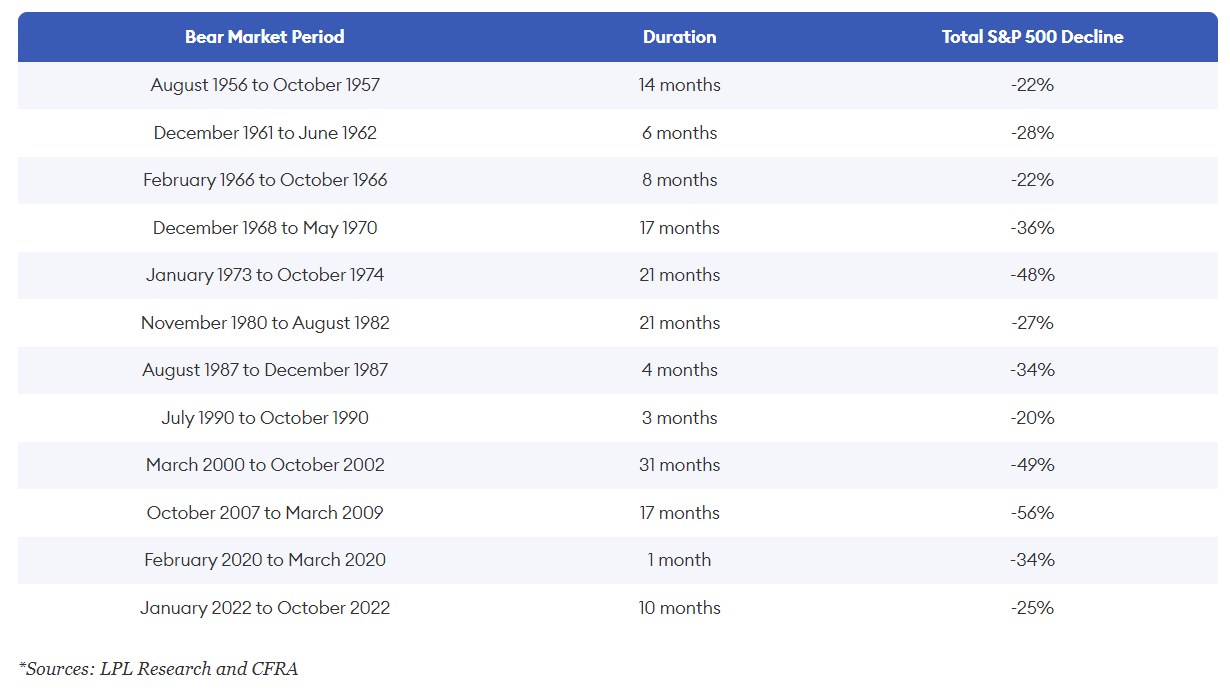
Trying to feel out or guess when we have a big correction is almost futile. Yes, there are some indicators professionals use to find market tops, but, if I’m not scared enough to hold more than 20% in cash, and usually not hold more than 10% in cash, then you should not be either. See the proof above again.
I have called all 5 of the last 4 (catch that) major corrections since 2000. That’s just not a lot of times we need to be super heavy cash. Good investors find a way to overcome your emotions and ignore your cognitive dissonance.

