Using Global Trends ETFs


Summary
- Asset allocation is at the heart of any portfolio, how you weight your asset allocation is over half of your risk and returns over time.
- ETFs are the best vehicles for building an asset allocation due to low cost ability to use to overweight favored asset classes and groups.
- Global Trends ETF monthly report helps you keep your asset allocation in line with secular (core holdings) and cyclical (tactical holdings) trends.
- Using or “slices” concept will help you stay organized and systematic in the face of volatile markets, which in turn helps you manage risk while you seek out profitable opportunities.
- Remember, scale in and scale out slow, except on big correlated market moves when you will move faster.
If you are using ETFs for part or all of your entire portfolio, then Global Trends ETF or Retirement Trends ETF is for you. With Global Trends ETF, you can find an easy way to invest into this generation of secular trends in an easy to use “slice” format.
What Is A Slice?
A slice is a portion of your portfolio that you want to fill in. Think of it as a slice in your portfolio pie.
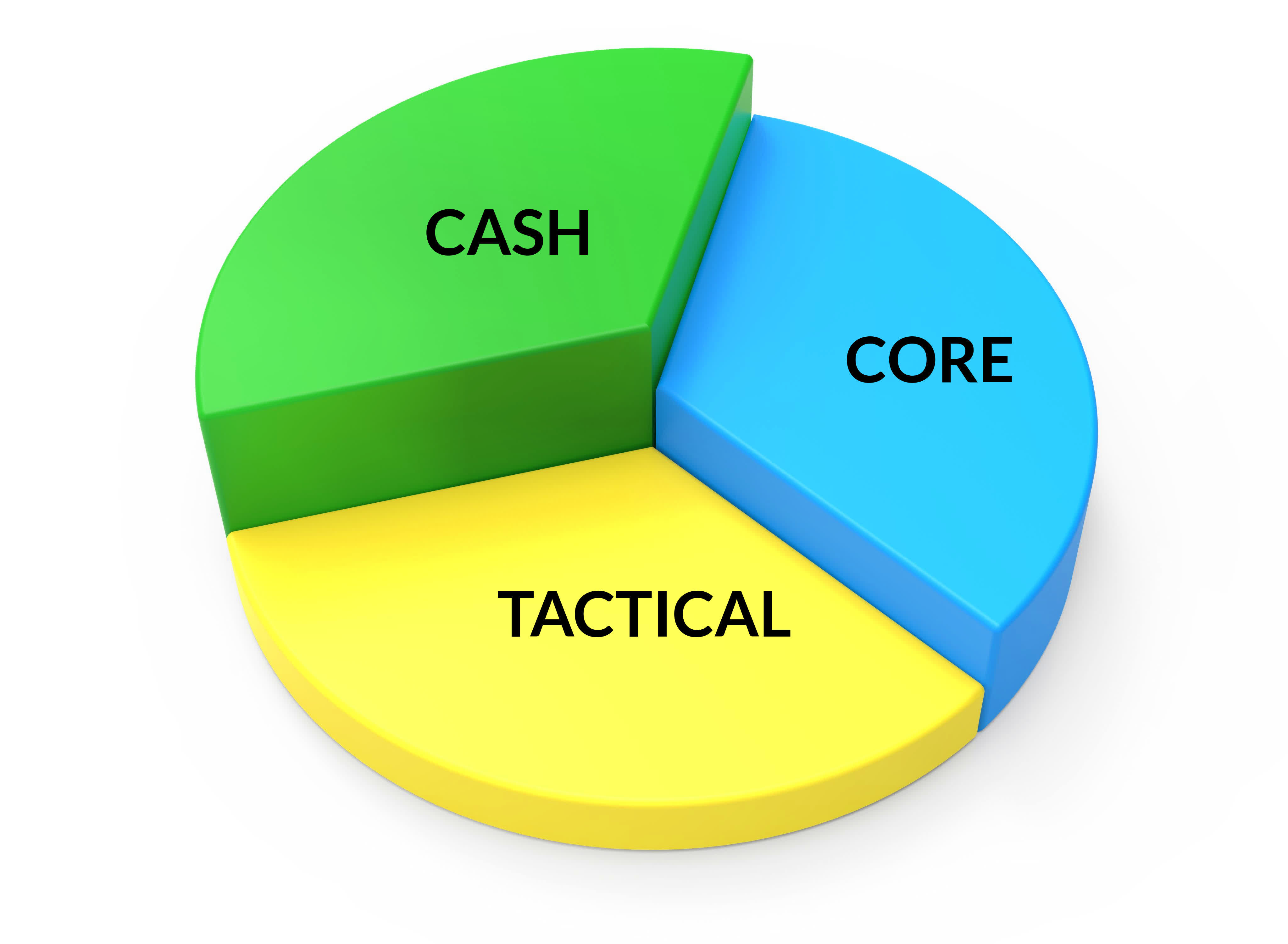
Your ETF portfolio will have 3 slices:
- Cash Holdings
- Core Holdings
- Tactical/Satellite Holdings
Each slice plays a specific role in your portfolio. Let’s look.
Your Cash Slice
Your first decision is how much cash to hold at any given time. This is your most important decision as it impacts both risk and reward.
- Higher cash levels act as a hedge against risk.
- Higher cash levels reduce potential return.
In general, you want to have low cash levels, however, in times of market turmoil, you will want to have higher cash levels for a short period of time, generally 2 years or less.
Here is an example of how to determine your cash slice:
| Investor Nature >>> | Aggressive | Moderate | Defensive |
| Long-term Cash % Target Range | 2-10% | 5-20% | 10-60% |
Your investment nature does not change with the markets. Rather, we simply try to increase or decrease our cash holdings depending on markets within the construct of our investment nature.
So, it is important that you understand your own nature. That will require a look at your finances, goals and emotions.
Ultimately, being unemotional when investing is important. That makes a sincere emotional self-evaluation important.
If you panic when your account is falling, then you want to compensate by having a plan that is probably a little heavier in cash as a rule, i.e. defensive investor, and requires less trading, i.e. more core holdings and fewer tactical holdings. Let’s look at core and tactical holdings concepts.
Your Core ETF Slice
Core ETF holdings are typically diversified, low cost and require very little management over time. This is where you will find diversified large cap and mid-cap ETFs, i.e. market cap based investing.
There are no small cap “core holdings” because small caps are an inefficient market. Consider that the Russell 2000 index of small and midcap companies never has more than half of the companies being profitable at any given time. Usually, only about one-third of the stocks are profitable or breaking even.
So, “core holdings” are from the mid caps and large cap domestic U.S. universe because these are the most efficient markets in the world. Typically, if the economy is expanding with growing money supply, large and mid cap ETFs will rise.
The ETFs that do best have a trend following or momentum component.
Interestingly, the various S&P 500 Index ETFs (SPY) (VOO) are, in fact, very slow moving, trend following indexes as they are market cap weighted.
Being market cap weighted gives those indexes a very slowly adjusting portfolio that adds to the winners and subtracts from the losers. That is why so may people do not beat the index. They do not have a way of slowly, methodically, systematically and unemotionally rebalancing their portfolios.
The question then is, can we beat the index? The answer is yes… with a little understanding and work.
When deciding how much to put into your core ETF holdings, you will start with your investment nature, i.e. aggressive, moderate or defensive. I tend to think in quarters to prevent headaches, but you don’t have to.
An aggressive investor might have a core that is smaller than their tactical/satellite holdings that they position trade or trend follow with.
A moderate investor might be split 50/50 core to tactical/satellite.
A defensive investor might have all core or 75% core holdings.
I generally only use 4 ETFs for building the core ETF slice of a portfolio.
| ETF Equities | Symbol |
| Invesco QQQ – Nasdaq 100 Stocks focused on secular leaders. | (QQQ) |
| Invesco S&P 500 Momentum – Focuses on the leaders in SPY. | (SPMO) |
| Invesco S&P Midcap Momentum – Focuses on appreciating midcaps being sucked towards inclusion in the S&P 500. | (XMMO) |
| Berkshire Hathaway – a mix of public and private companies with a bit lower risk than the S&P 500 and a bit more upside. | (BRK.B) |
You caught me, Berkshire Hathaway is not an ETF, but we use it like it was. Berkshire’s massive free cash flow from wholly owned companies and ability to lend to companies during periods of correction, along with its focused publicly listed global stock portfolio gives Berkshire a bit more upside than the S&P 500 over time with a bit less risk in my opinion. Their makeup is much like a private equity firm, which offers unique opportunities and diversification.
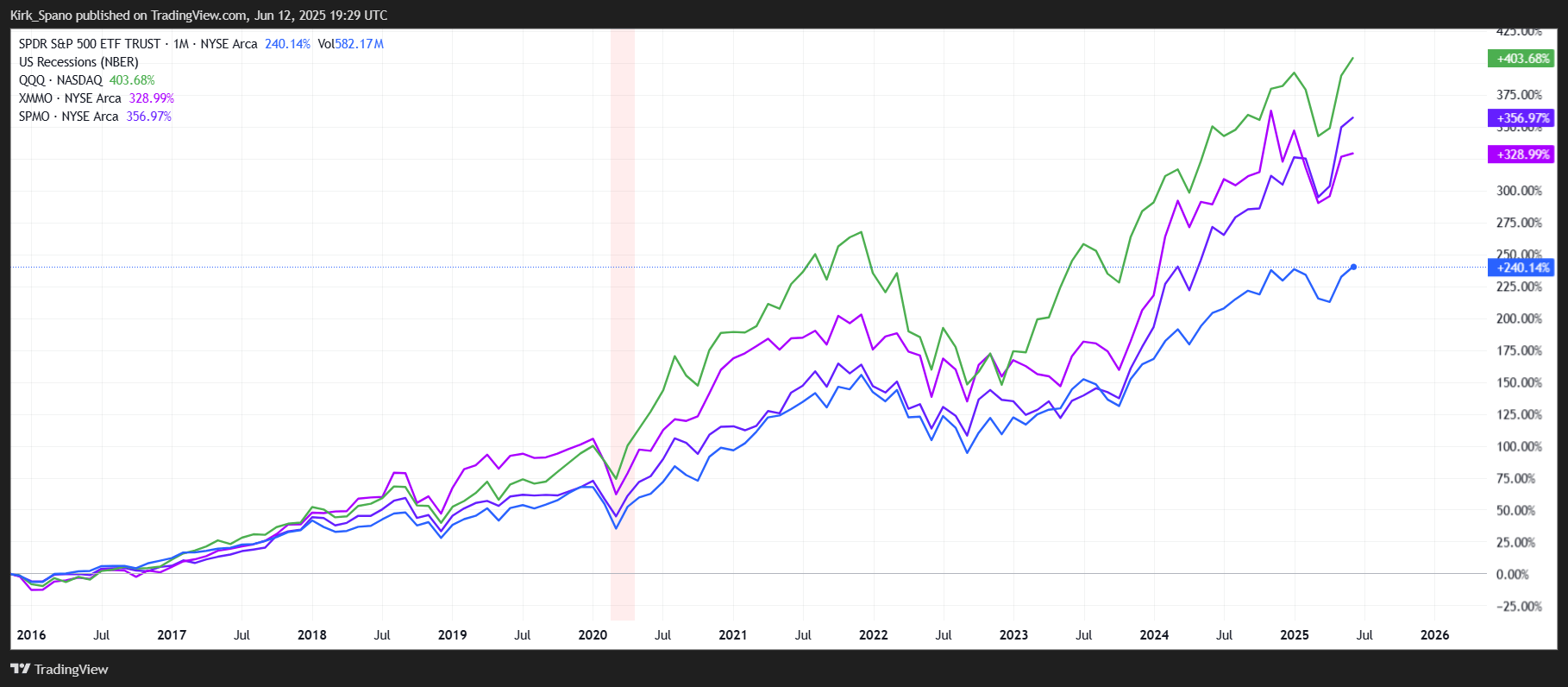
QQQ is built with exposure to more secularly driven industries and that has made it a leader versus the S&P 500 ETFs since before and after the dot com crash – inclusive of dividends.

BATS:SPY Chart Image by Kirk_Spano

The momentum ETFs also have beaten the S&P 500 over most time frames due to being just a little quicker to rebalance towards winners and reducing laggards.
BATS:SPY Chart Image by Kirk_Spano
Past performance is on guarantee of future results, however, I think it is a harbinger in many cases, especially when the thesis makes sense, as it does here.
Your Tactical/Satellite ETF Slice
Tactical ETFs are typically NON-diversified. This is where we find our sector, industry, regional and single-nation ETFs.
Importantly, by owning several non-diversified ETFs, you are actually adding to your diversification. Most analysis suggests that exposure to about 200 stocks globally is the sweet spot on diversification and upside. We try to gravitate towards that exposure level.
Often, if you “x-ray” your portfolio, you’ll see exposure to 500+ companies. Upon further examination, most of the allocation of the ETF is to less than half of the names in the portfolio. This is the nature of ETFs. The top 10 or 20 holdings in an ETF usually account for over half of the allocation. We focus on those. The fractional exposures are important, but not as important as the larger exposures.
How much you put into your Tactical ETF slice depends on your nature and how much you want to trade. Generally speaking, if you are defensive by nature, then do not trade tactically.
Here are the maximum tactical holdings guidelines I suggest:
- Aggressive investors up to 75% in tactical/satellite (me). This is only recommended if you are consistently contributing money to your account so that you can “buy the dips.”
- Moderate investors up to 50% tactical. This is more common. I use this slice approach for very many of my investing clients.
- Defensive investors up to 25% tactical. If you are defensive, then a maximum of a quarter tactical prevent over-extending on risk, or, just use the core ETFs and then add a few individual securities that make sense for you.
I keep the ETF page of the Very Short List updated and am willing to hear suggestions. A few guidelines:
- Liquidity – traded heavily enough to offer easy in and out.
- Options – not a requirement, but I prefer ETFs I can sell options on.
- Expenses – I don’t want to overpay.
- Opportunity – have some cyclical or secular characteristics I can use in my asset allocation at least sometimes.
Monthly Update & My Trade Alerts
I write a monthly Global Trends ETF Asset Allocation Update. It is not a universal recommendation, as nothing I do is because your situation is different.
The Global Trends ETF is a guide for you to use to build an asset allocation that makes sense for you. It is also useful for positioning your 401k assets, which for many, are your core holdings account.
My trade alerts go out when I make a move in client portfolios at my investment firm, not every time something might trigger in theory technically.
It is important that you learn some technical analysis, at least how to understand what you are being shown and told. You do not have to become a great technical analyst, but you need to be able to incorporate it with some understanding.
If you are starting new with us or looking to reallocate, remember to follow our standard scaling in approach of “slow, small and at wide price points.” About the only exception to that is after a crash that has started to trend sideways and choppy for a couple weeks. In those instances, a few times per decade at most, we might pile in if we think the worst is behind us.
You are managing your own money, so consider how trades fit into your slices. The trade alerts may or may not apply to you. To steal a phrase from younger folks, “you do you.”
Closing Investment Quick Thoughts
By creating 3 basic slices for your ETF portfolio you can make your job as a do-it-yourself investor a lot easier. If you also want to buy stocks, then just add another slice for stocks. If you want crypto, add a crypto slice.
Do not fall into the trap of “cash is trash.” Cash is an asset class that deserves respect. The U.S. Dollar was a top performer in 2022 and is now becoming a great tool to buy other cheaper assets. Bottom line, cash is a great hedge in times of turmoil and, unlike shorting, does not require precision trading skills.
When building your portfolio, I once again remind you, generally invest in line with the secular trends. That is where the big tailwinds are.
Make sure to follow along in chat where I will drop in most days. Also, if you are looking for a consult on your portfolio and some coaching, I offer that exclusively to subscribers of my investment letters at my investment firm.

